
Muhammed Shihad | Published on 21/09/2026
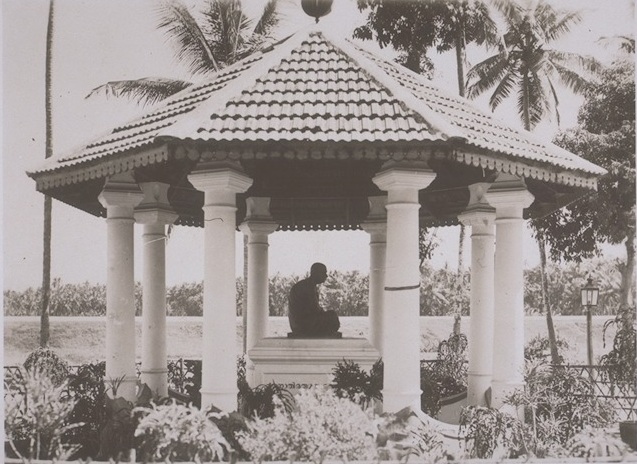
Most memorials are built after a great life ends. In Thalassery, one was raised while the man it honoured was still walking among his people. In March 2027, that statue completes 100 years, a centenary milestone for Kannur’s heritage and for everyone who values the Guru’s message.
On 13 March 1927, a bronze statue of Sree Narayana Guru was unveiled at the Sree Jagannath Temple. It is widely recorded as the first statue of the Guru made in his lifetime, sculpted in Italy by Prof. Tavaroli. But the statue is only one thread. Kannur district holds a whole chapter of the Guru’s life: two temples he consecrated, a community organisation he blessed, disciples who left Kannur to follow him, and a meeting with a young man from a Muslim trading family that still deserves to be told.
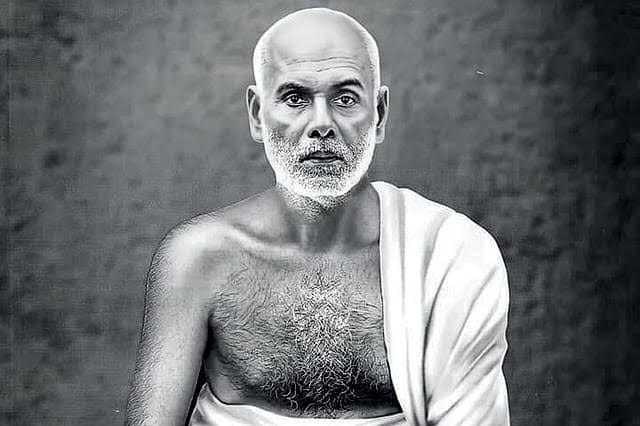
- Sree Narayana Guru (Image: Open Magazine)
A Statue Raised in the Guru’s Lifetime
The idea came from Moorkoth Kumaran, a teacher, writer and SNDP Yogam leader who did more than almost anyone to spread the Guru’s ideas across Malabar. Records say the bronze took fourteen months to complete and was unveiled on 13 March 1927, after Bodhananda Swamikal, the Guru’s disciple and successor-designate, consecrated it.
A lovely detail survives about how the likeness was captured. Kumaran sent Pattatharil Shekharan, a Thalassery photographer, to Sivagiri to photograph the Guru. Shekharan was nervous about telling a saint how to pose and had in mind the profile portraits seen on coins of the day. The Guru first teased him with a question about whether his camera could capture the essence of a mango, and then took exactly the pose the photographer had imagined. That same photograph is said to have inspired the ₹5 commemorative coin issued in the Guru’s honour decades later.
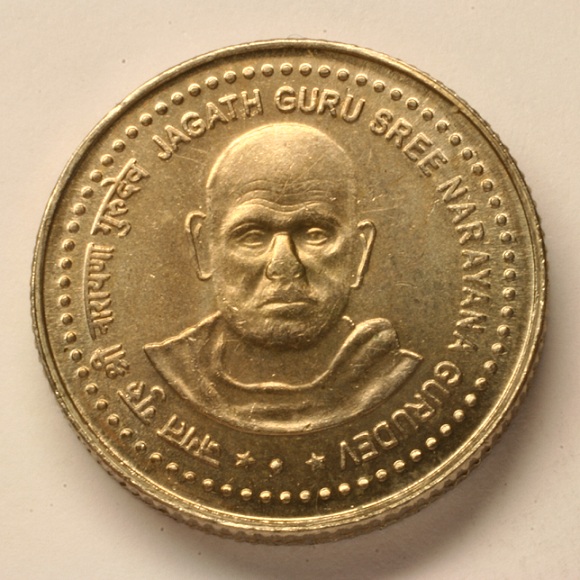
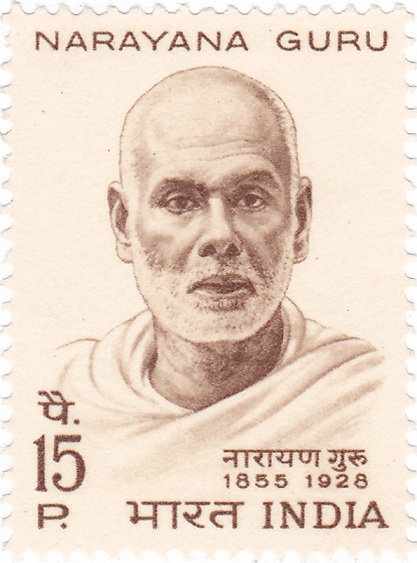
- Sree Narayana Guru ₹5 Coin and Commemorative Stamp issued by the Government of India in 1967.
The Guru himself is said to have glimpsed the statue at Colombo as it travelled from Italy. Imagine it: a teacher who never asked to be worshipped, watching his own bronze likeness pass by on its way to Malabar.
A Temple Built to Open Doors
To understand the statue, you have to understand the temple. In December 1904, Varathoor Kaniyil Kunhikannan travelled to Sivagiri to ask the Guru to consecrate a temple in Thalassery. The Guru was hesitant, since Malabar’s Thiyya community was already better educated and more prosperous than many in the south. Kunhikannan’s answer, as it is remembered, was that material progress had come but spiritual dignity was still shut outside the gate. The Guru agreed.
He sent the poet Kumaran Asan to convene the first public meeting on 9 July 1905, and consecrated the temple in 1908, with Shiva as the presiding deity and a design inspired by the Jagannath temple at Puri. From the 1920s it was open to people of every caste.
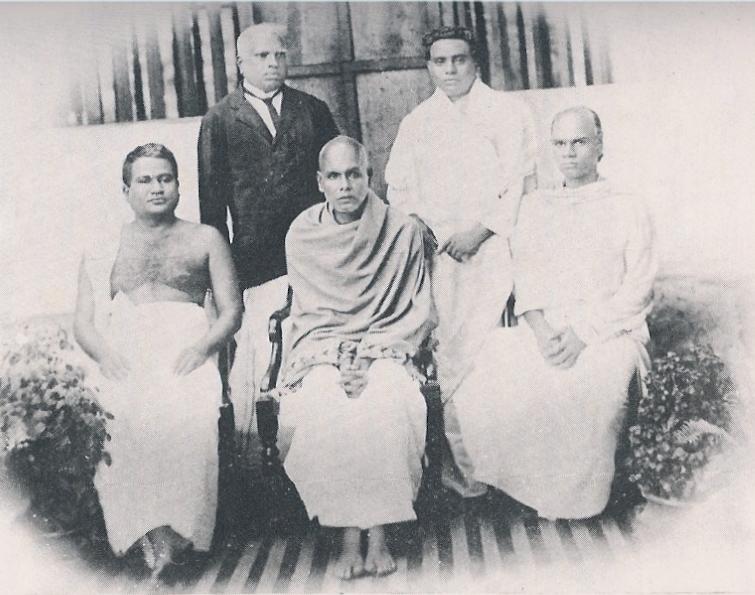
- Kumaran Asan with Guru (Image: Wikimedia)
Two stories from that time capture the Guru’s method. When orthodox voices resisted the entry of Dalits, they asked for a varsham to pass first. In Malayalam, varsham means both “year” and “rain”. The story goes that rain fell soon after, and the Guru smilingly observed that a varsham had now passed, so the doors should open to all. Laughter settled the argument. The second story is about Bodhananda Swamikal, who is said to have protested against idol consecration at Thalassery, only to be so moved on meeting the Guru that he became his disciple. Years later he would be the one to consecrate the Guru’s statue in the same temple.
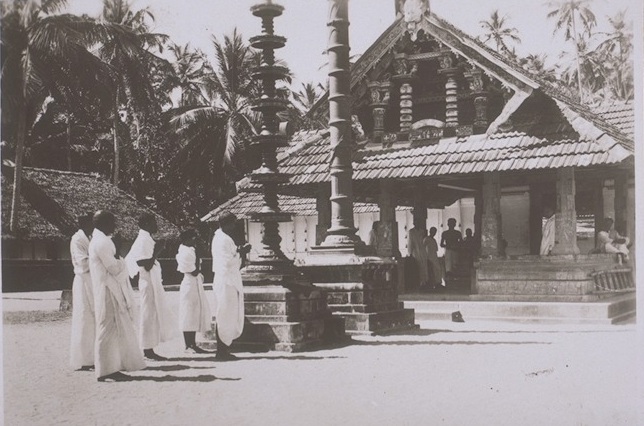
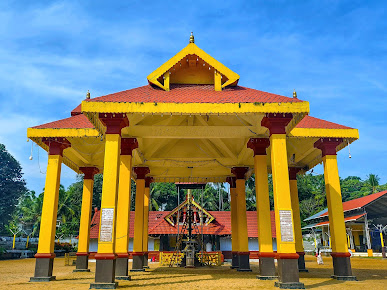
- Shri Jagannatha Shiva Temple, Thalassery — Then and Now. Left: Archival photograph from the 1920s. Right: Recent photograph, courtesy of the Sivagiri Madom website.
Kunhikannan, the man who brought the Guru to Thalassery, once asked for sannyasa and was gently refused, told it was not his path in this lifetime. The Guru did grant his humbler wish, to be laid to rest in samadhi. It is a small, human detail that shows how personally the Guru tended to those who worked beside him.
The Guru’s Footprints Across Kannur
Thalassery was not a single visit. Between 1904 and 1938 the Guru’s presence, and his ideas, threaded through the district:
Dec 1904: Varathoor Kaniyil Kunhikannan meets the Guru at Sivagiri and proposes a temple for Thalassery.
9 Jul 1905: First public meeting at Parambath House, Thalassery, convened by Kumaran Asan on the Guru’s behalf.
1907–08: The Guru visits Kannur and stays at Kottiyath Choyi’s home. A temple committee is formed; the Bhakti Pradeepa Yogam (later Bhakti Samvardhini Yogam) is formally set up on 16 Feb 1908.
Feb 1908: Sree Jagannath Temple, Thalassery, is consecrated.
11 Apr 1916: Sree Sundareswara Temple, Kannur (Talap), is consecrated in a pre-dawn muhurtham under the Pooyam star.
13 Mar 1927: The Italian-made bronze statue of the Guru is unveiled at Thalassery, in his lifetime.
1938: The Guru’s statue is consecrated at Sundareswara Temple, with its flagstaff and lamp post.
Kannur also gave the Guru disciples. Anantha Shenoy, a Gandhian from Kannur, read in Young India about Gandhi’s reflections after meeting the Guru, was deeply moved, and eventually took sannyasa as Swami Ananda Theerthan, regarded as the Guru’s last initiated disciple. And when the Guru arrived at Thalassery railway station, a young man from Koyilandy, in town for the Civil Service examination, could not get through the crowd without missing his train. He wrote a poem instead and sent it through a friend. The Guru read it and blessed him, and the young man later became known as Sivananda Yogi of Koyilandy. Heritage, again, hides in railway platforms.
A Seeker from Valiyakandy: The Guru and Icha Mastan
If the temple-entry story is the head of this chapter, the encounter with Abdul Khader Masthan is its heart.
Masthan belonged to the Valiyakandy family of Kannur city, a traditional Muslim family in the copper trade. He had heard about the events at Thalassery, where people once kept at the gate were now being welcomed in, and he came to meet the man behind it. According to accounts in Malayalam writing on the Guru and the Sufis, the conversation was short and direct.
Masthan began by asking whether the Guru was the one who had installed the idol. The Guru said yes, and turned the question around by asking whether Masthan would like to see God. Masthan wondered aloud whether God could really be seen. The Guru replied that ordinary eyes cannot perceive the divine, but invited him to take his hand and look towards the horizon. What followed is described as a deep trance. When Masthan came back to himself, he said only, “I have seen God.”
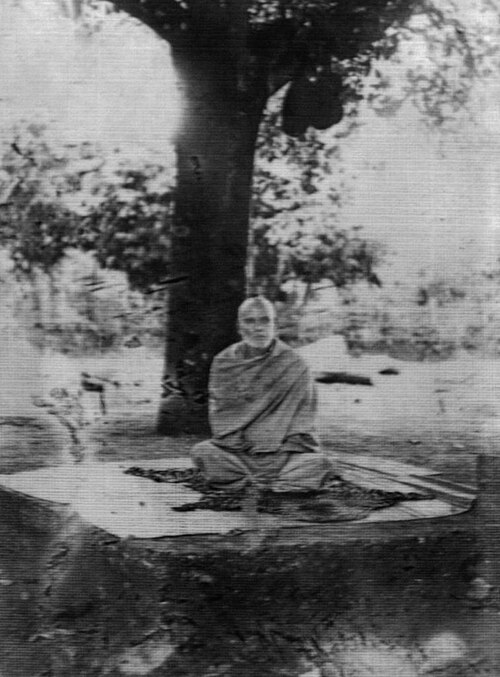
- Sree Narayana guru at Meditation (Image: Wikimedia)
Some time later Masthan returned with a copper plate from the family trade, inscribed in classical Tamil. He could not read it and asked the Guru for help. The Guru studied the plate but did not give him the reading. Instead he advised Masthan to consult Sufi saints in Tamil Nadu. Masthan did, and a Sufi teacher explained the inscription as a Sufi text. The journey transformed him into the revered mystic known as Icha Mastan, who composed devotional poems, including verses in praise of Lord Shiva.
Message Over Monument
The Guru never wanted to be worshipped as an idol himself. His life kept moving away from ritual and toward reason, education and self-respect. His well-known call was for one caste, one religion, one God for humankind. In 1927, the same year the Thalassery statue was unveiled, he consecrated a mirror at Kalavancode inscribed “Om Shanti” instead of a deity, and urged people to prefer schools over more temples. When he organised India’s first All Religions Conference at Aluva in 1923, the spirit was that people had gathered to understand one another, not to win arguments.
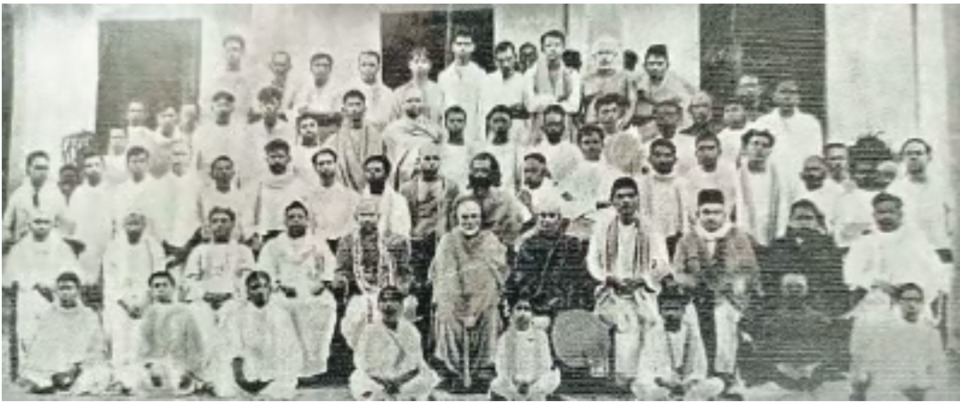
- A photo taken during the all-religion meet at Aluva in 1924 (Image: Wikimedia)
The statue, then, is best read as a teacher’s portrait. It asks visitors to carry the Guru’s message out of the courtyard and into their own lives.
Lessons for the Present: The Enduring Relevance of the Guru’s Message
Education as a Path to Empowerment: The Guru placed education, organisation and self-reliance at the heart of social progress. His work encouraged communities to recognise knowledge as a means of overcoming social and economic barriers.
Dignity and Equality for All: The opening of the temple to people across caste boundaries reflected the Guru’s conviction that dignity and spiritual access should not be limited by social status. His message challenged practices that excluded people from places of worship and public life.
Heritage as a Living Tradition: Heritage is not limited to monuments, objects or historical records. The statue, temple, museum and associated traditions remain meaningful because communities continue to engage with, interpret and pass them on to new generations.
Reform Through Collective Effort: Social change rarely comes from one individual alone. The story of the Thalassery temple and statue reflects the combined efforts of community leaders, poets, teachers, artists and ordinary people who transformed an idea into a lasting legacy.
Walk the Guru’s Kannur
If you are visiting, go beyond the darshan. Look at the ceiling carvings at the Jagannath Temple, spend time in the museum on the Guru’s works, and stand before the statue and ask what it meant to install it in 1927, less than two years before he passed away in 1928. Then travel on to Sree Sundareswara Temple in Kannur city, and walk out into the lanes where temples, mosques and churches share one skyline.
There is also work to be done. Icha Mastan’s story survives largely in oral memory and a few written accounts. A community-led oral history project, gathering the recollections of families and elders in Kannur, would give this meeting between a reformer and a Sufi the documentation it deserves. That is the kind of living heritage our foundation believes in.
Preserving heritage is about protecting the ideas that made these places matter, as much as protecting stone, wood and bronze. The Guru’s central idea, a society where no one stands outside the gate, is still unfinished work. Our generation’s task is to continue it.
Welcome to Thalassery and Kannur—where centuries of history continue to live through its streets, stories, traditions, and communities.
Journey with City Heritage through Thalassery and Kannur—Discover a remarkable heritage shaped by maritime connections, royal traditions, colonial encounters, diverse faiths, architecture, cuisine, and generations of local communities.
Visit us and Contact:
Visit: www.cityheritage.in
Email: mail@cityheritage.in
Instagram: cityheritage.in
Phone: +91 7356569573, +91 8377024979




 (1).png)
© Copyright 2026 City Heritage. All rights reserved.
Website designed by TNM Online Solutions.
If you have any enquiry, feel free to ask, and we'll provide you with a prompt and concise response.