
Yasin Asharaf P | Published on 03/02/2026
A ‘Star’ from the Sky, Sunita Williams Walking Through Calicut’s Beauty & Heritage
As a storyteller, I found myself wondering how to begin—how does one tell stories to a ‘star’ who returned from the vastness of space carrying countless stories within her. Just a day earlier, with the Arabian Sea standing as a quiet witness, Sunita Williams had spoken words that shifted the air around us: “We are all here together on one planet.” In that instant, boundaries softened, and a profound call for equality echoed across all humankind.
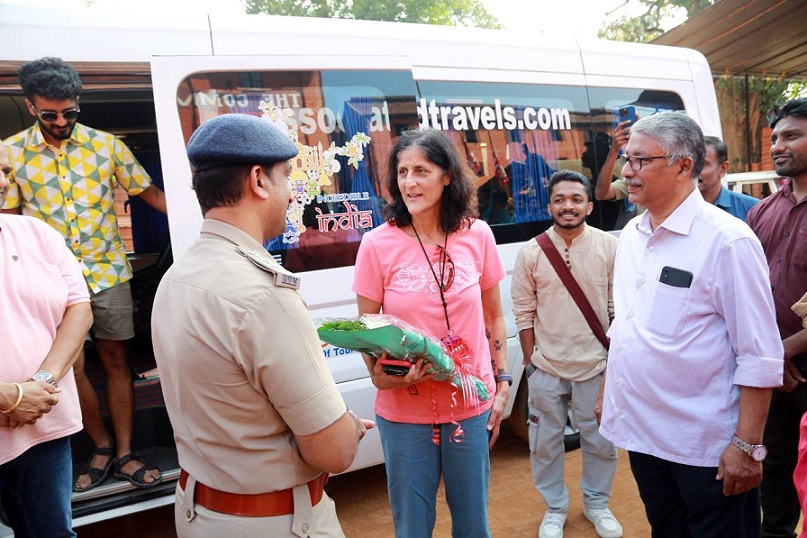
Her words deeply inspired me, and I found myself longing to meet the “star” in person. It was early morning at Kadavu Resort, a place where nature offers pure calm—the sun preparing to rise, birds filling the air with song, and soft morning light guiding us toward the reception. At sharp 7:30 a.m., Sunita Williams arrived at the reception, just as we were ready to begin our journey.
It was a joyful moment to know that her father was from Gujarat, India, and that eight members of her father’s family from Gujarat had arrived the previous day. Accompanied by her relatives, we began our journey in a small van with wide, beautiful windows, heading toward Kadalundi Bird Sanctuary for a boat ride. Reaching the sanctuary early in the morning is essential—to fully experience its quiet beauty as it awakens.
A seventh-standard girl from the family asked her questions with shining curiosity—about her dog, about astronauts like Kalpana Chawla, and about the world beyond Earth. Sunita answered with warmth, sharing her stories as naturally as a smile. Perhaps seeing Earth from space has taught her how small we all are, and how gently we should speak to one another. That is what makes her so open, so easy to talk to, and so alive in every moment.
To the Beauty of Calicut..
We arrived at the Kadalundi boating centre in the early morning light. Two boats waited quietly, ready to carry us into the calm beauty of Calicut. As the boats began to move, a story slowly unfolded—starting not with answers, but with a question: Why was this city so special that the world once came searching for it?
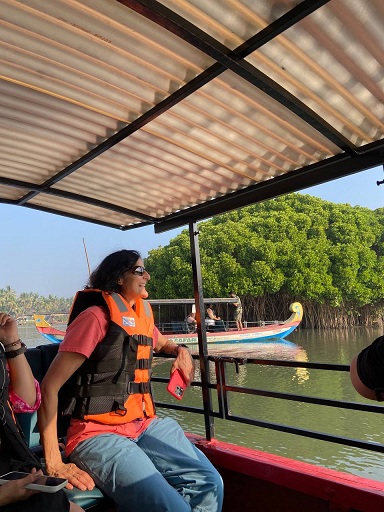
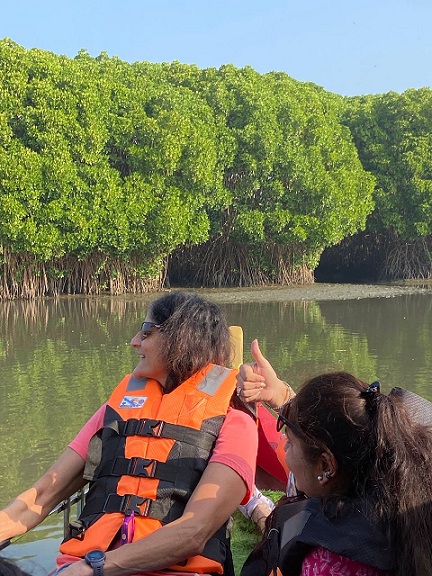
Romans and Greeks, Egyptians and Chinese, Arabs and Europeans—all had followed the same currents to this shore. I spoke softly of Tyndis, the ancient port city, and of Kozhikode’s deep ties with a world far beyond its horizon. With unhurried attention and gentle curiosity, Sunita Williams and her family listened, as Calicut revealed its stories—one tide, one memory at a time.
As the boat slowly moved forward, a quietness entered our minds. Leaving behind the crowded world, we surrendered to the cool river breeze, the hushed murmurs of migratory birds, the rhythm of flowing water, and the deep green embrace of the mangroves. Not wanting to disturb the calm, I spoke softly—of Kerala’s beauty and its forty-four rivers that thread across the land. This Kadalundi River is born in the silent folds of the Western Ghats, journeying patiently until it meets the Arabian Sea at this very shore.
Once, this river carried more than water. It bore spices, timber, and the wealth of the hills, traveling from the Western Ghats to the waiting sea. From here, great ships and Urus sailed outward, carrying Calicut to distant corners of the world. In this gentle flow of words and water, the meaning of Calicut’s uniqueness slowly revealed itself.
She watched nature with a quiet attentiveness, her eyes following the flight of migratory birds, pausing often to ask their names. Each time, the boatman, Adarsh—a young and enthusiastic guy—answered with ease, as the river continued its timeless song.
The young girl continued speaking without pause, her curiosity endless. As the boat glided gently forward, she kept talking—her questions flowing as freely as the river beside her. She asked about the migratory birds resting along the banks, the tangled roots of the mangroves, the shifting patterns of the water, the fish darting beneath the surface, and even the vast, ever-changing sky above them.
In the middle of her excited observations, something else caught her attention. She noticed the small, affectionate dog tattoos on Sunita Williams’s hands. Her voice softened, and with a hint of sadness she said, “It’s so unfair that dogs live for such a short time. Why can’t they stay with us for a few more years?”
Sunita Williams listened patiently, taking in every word. With a gentle smile shaped by her own life experiences, she replied calmly, turning the child’s sorrow into quiet understanding.
Meanwhile, the girl leaned forward and dipped her hands into the river. Curious once again, she tasted the water and laughed in surprise.
“It’s salty,” she said—discovering, in that simple moment, yet another secret the river had to share.
Sunita grew visibly excited when the boatman spoke about the river beside us—how it quietly separates two districts. I went on to explain that rivers define almost the entire map of Kerala, with forty-four of them flowing across the state. Listening to this, she looked around in amazement, sensing the natural wealth of the land and its quiet abundance revealed the meaning behind the name God’s Own Country.
The boat soon reached a stretch where dense mangroves blended seamlessly with the river. They stopped there for a while, allowing the quiet and calm of nature to sink in. In that peaceful setting, she noticed a traditional fishing arrangement and immediately asked about it.
It was one of Kerala’s age-old fishing systems: a long net carefully laid out to enclose an area, with three fish traps fixed at one corner. As the tide recedes and the water level drops, fish are guided into the traps and held there. By sheer luck, the fishermen arrived at that very moment to collect their catch.
Adarsh gently steered the boat closer, moving slowly so as not to disturb the scene. When Sunita Williams asked how to speak to the fishermen, I quickly taught her a few Malayalam words. Gathering her voice, she called out cheerfully,
“Meen undo?” — Is there any fish?
The fishermen replied with a smile, and soon the catch became visible. The entire team watched in excitement as traditional fish, including colan (garfish), were pulled from the traps. Seeing the fish caught by the three fishermen in this time-honoured way turned the moment into a living lesson—where nature, tradition, and human skill came together in perfect harmony.
As we neared the starting point, a relative expressed a wish to try rowing the boat. Adarsh stepped in with a smile, patiently explaining the movements and guiding the hands. Yet, despite the effort, the boat refused to obey, drifting stubbornly with the river’s will.
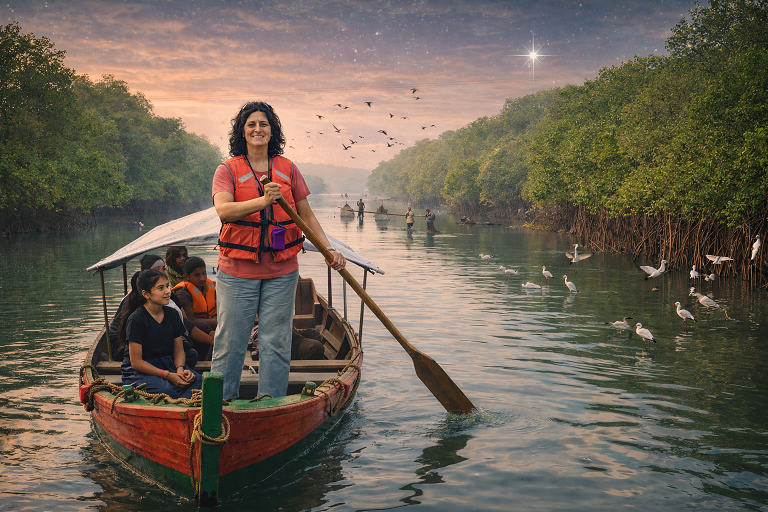
Then Sunita Williams stepped forward. With a quiet smile, she took the oars and moved into the driver’s position. Her strokes were steady and assured, and soon the boat found its path, gliding smoothly in the right direction. Years of training, discipline, and experience revealed themselves—not in force, but in calm readiness to meet the unfamiliar.
Watching her then, awe came naturally. The courage she carries beyond Earth was present here too, reflected in every measured stroke of the oar—a gentle reminder that the bravery within her travels wherever she goes, on this planet and far beyond.
Before leaving, she left behind a few gentle words in the visitors’ notebook,:
“Thanks for an amazing and peaceful journey through the Kadalundi River. I understood the river a little more today, and with it, the soul of Kadalundi. Grateful to everyone who made it possible to experience and feel the living cultural heritage of Kerala.”
To The Living Heritage of Calicut..
Carrying the calm and quiet happiness gifted by the boat journey, we moved towards a place where heritage is not preserved in silence, but alive in sound. The peaceful rhythm of water slowly faded, replaced by the steady noise of massive German-made machines still at work.
This is not a place of tranquillity. Instead, it offers something far richer. For more than a hundred years, these machines have continued their labour, carrying forward a legacy that refuses to rest. This is the Commonwealth Tile Factory, where history does not sleep—it works.
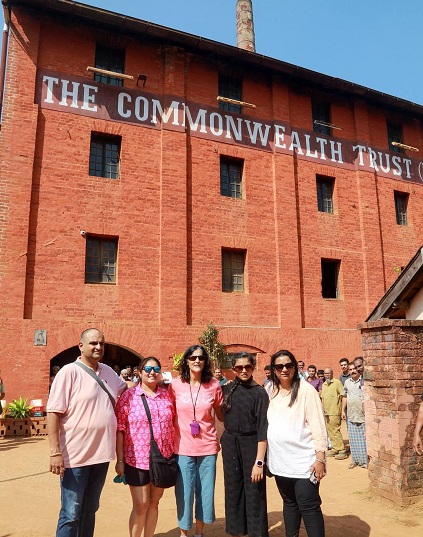
Sunita Williams was welcomed by a team of more than 100 workers at the factory, their presence echoing the spirit of a place still alive with human effort. As we stood there, we began not with answers, but with a question: Why would a Christian missionary build a tile factory in Calicut?
For a moment, the question lingered. The team exchanged thoughts, some puzzled, some curious, unable to immediately grasp the deeper reality behind it. Then I began the story.
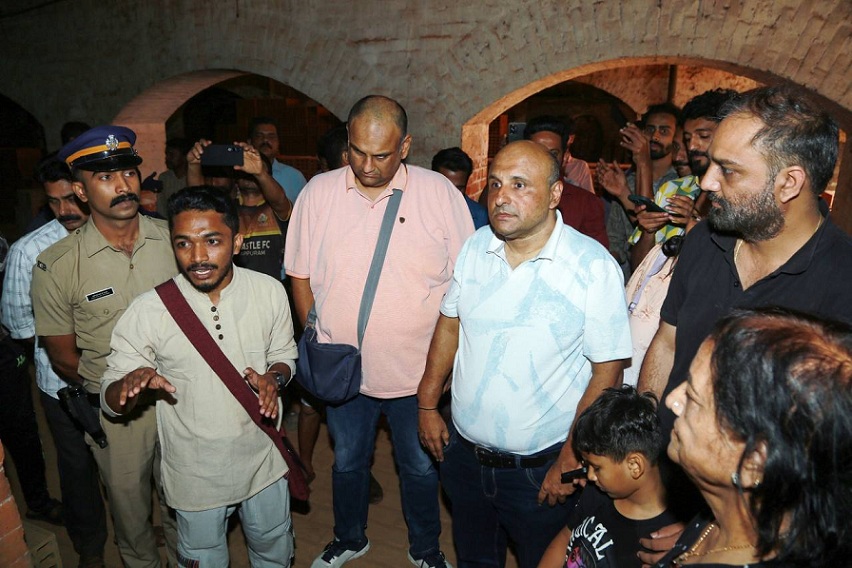
More than a century ago, the Basel Evangelical Mission, a European Christian missionary organisation, established this massive tile factory along the banks of the Chaliyar River, close to the Feroke railway station. It was not built merely of brick and machinery, but of purpose—to provide employment and stability to those who had embraced a new faith.
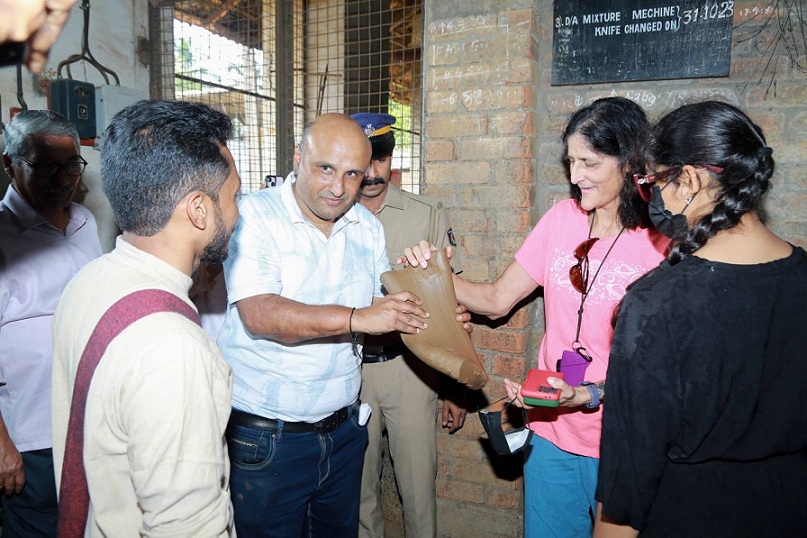
We then moved deeper into the heart of the factory. Jijo Valsan and a few others from the factory joined us, guiding the way and patiently explaining the working system that had sustained this place for generations. Step by step, the process unfolded before us—from the careful mixing of soil to the firing of the tiles, and finally to the sorting of the boiled tiles into different classes.
Along the way, history quietly entered the conversation. We spoke about the transformation of Calicut’s homes, how thatched roofs slowly gave way to tiled ones with the arrival of tile factories in Feroke, reshaping both the skyline and everyday life.
At the finishing section, where freshly made tiles awaited their final touch, Sunita Williams decided to try her hand at the craft. With the workers guiding her, she carefully shaped the tile using a knife, sharing a moment of respect for the skill behind this age-old labour.
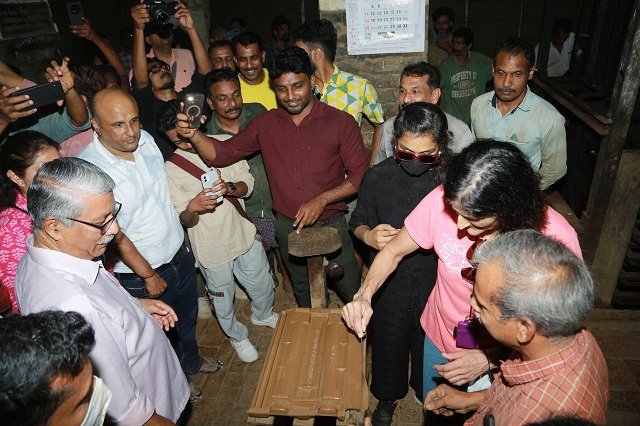
The second floor of the factory, the drying area, is perhaps its most beautiful space. Long rails stretch across the floor, and neatly arranged rows of tiles create an unexpected sense of order and elegance—something that quietly captivates everyone who walks through.
It was here that a worker invited Sunita Williams to step onto the rails, usually reserved for carrying tiles between different sections of the factory. For decades, these tracks had borne the weight of relentless labour. Now, they offered a rare pause. Sunita glided forward a few metres, effort-free, a gentle smile appearing on her face—a simple moment, yet filled with quiet joy.
Below, on the ground floor, the atmosphere told a different story. The boilers roared at nearly 900 degrees Celsius, filling the air with intense heat. Sweat covered the team—and Sunita as well—reminding us that behind the beauty of the drying floor lies the raw effort and endurance that keep this living heritage alive.
With a heartfelt handshake and words filled with gratitude, she returned to Calicut city to explore more stories alongside Dr. Ajamal Mueen. The river and the soil had already shared their tales with her, leaving behind a quiet sense of peace and gentle joy.
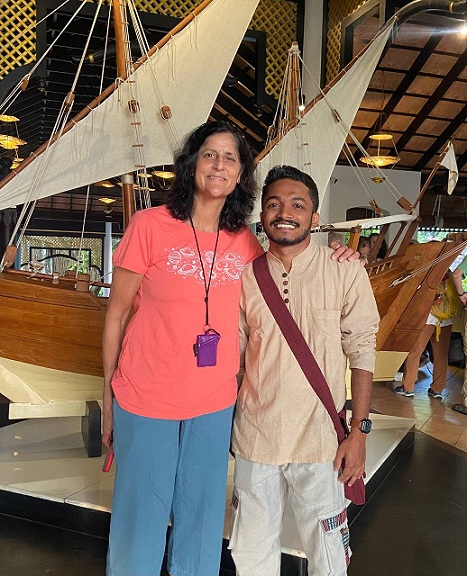
City heritage storyteller Yasin Asharaf with Sunita Williams
This morning, in its own unhurried way, offered her something rare—an opportunity to feel the beauty and living heritage of God’s Own Country, not from the silence of space, where Earth looks like a tiny point of light, but from the land itself—where history works, people breathe, and life continues.
Visit us and Contact:
Explore the fascinating beauty and history of Calicut. Contact us for an unforgettable heritage walk & story telling.
Get in Touch:
Visit: www.cityheritage.in
Email: mail@cityheritage.in
Instagram: cityheritage.in
Phone: +91 7356569573, +91 8377024979




 (1).png)
© Copyright 2026 City Heritage. All rights reserved.
Website designed by TNM Online Solutions.
If you have any enquiry, feel free to ask, and we'll provide you with a prompt and concise response.