
- Editorial Team, CITY HERITAGE
The history of Malabar is woven with stories of trade, colonial ambition, resistance, and cultural transformation. Among the many figures who shaped this complex history, few remain as fascinating and controversial as Murdoch Brown — a Scottish adventurer who rose to prominence on the Malabar Coast during the late eighteenth and early nineteenth centuries.
Merchant, diplomat, plantation owner, linguist, and colonial entrepreneur, Murdoch Brown left an enduring mark on Kannur and the wider Malabar region. His legacy survives not only in historical documents and colonial records, but also in the landscapes of Anjarakandy, the archives of St. John's Anglican Church, and the memories preserved through generations.
Several years ago, this forgotten chapter of Malabar’s past came alive once again when the fourth-generation descendants of Murdoch Brown visited Kannur in search of their ancestral roots — a journey that became deeply connected with the efforts of City Heritage to preserve and reinterpret the history of Kerala.
A Scottish Adventurer Who Journeyed to India
Born in Edinburgh in 1750, Murdoch Brown belonged to a generation of Scots who looked beyond Britain in search of opportunity. Scotland during the eighteenth century offered limited prospects for ambitious young men without political influence or aristocratic patronage. Brown, like many Scots of his era, turned his eyes toward continental Europe and the expanding global trade networks connected to Asia.
As a young man, Brown travelled to Lisbon, where he is believed to have found employment. It remains unclear exactly when he first decided to travel to India, but without influential connections, securing a position within the powerful English East India Company would have been extremely difficult.
At that time, Europe was filled with competing trading powers. Alongside the English East India Company existed the Dutch VOC, the French, Danish, Swedish, and Ostend East India Companies. Many independent merchants and adventurous Scots found opportunities within these multinational commercial networks.
It is believed that Murdoch Brown first reached India around the age of twenty-eight as part of the crew of the merchant vessel Joseph and Theresia. Merchant ships operating between Europe and India depended heavily on the rhythm of the monsoon winds. These vessels travelled from port to port along the Indian coast collecting spices, pepper, textiles, and other goods before returning to Europe.
Because ships could remain only briefly on the coast before seasonal winds shifted, trading companies often left trusted representatives behind to negotiate contracts and prepare future cargoes. Historical evidence suggests that Murdoch Brown may have been one of these representatives — beginning what would become a lifelong relationship with Malabar.
Trade Networks and Colonial Rivalries on the Malabar Coast
The Malabar Coast during the eighteenth century was one of the most globally connected regions in the world. Ports such as Calicut, Tellicherry, Cannanore, Mahé, and Alleppey were hubs of international trade where European companies competed fiercely for access to spices and pepper.
Calicut alone hosted trading compounds belonging to the British, French, and Danish companies. Local rulers such as the Zamorin still retained significant influence and negotiated carefully with European powers to protect their own political and commercial interests.
Murdoch Brown appears to have initially worked for the Danish Company, particularly in Alleppey and later in Calicut. During this period, he became deeply familiar with the languages, customs, and commercial systems of Kerala. Historical accounts describe Brown as a remarkably gifted linguist who eventually spoke several European languages alongside multiple Malayalam dialects and Oriental languages.
Mahe, Tipu Sultan, and the Shadow of War
By the early 1790s, Murdoch Brown had moved to Mahé, the small French settlement near Tellicherry. Mahe occupied an extremely strategic position during the Anglo-French conflicts and the wars involving Tipu Sultan.
Historical correspondence suggests that Murdoch Brown played an important commercial role during this turbulent period. British officials in Tellicherry accused Brown and other merchants of supplying Tipu Sultan with military goods, muskets, and commercial resources outside East India Company control.
This created considerable hostility toward Brown among British military and political circles. Yet it also reveals the extent of his influence and the complexity of loyalties along the Malabar Coast, where merchants often navigated between competing empires and political powers.
At Mahe, Brown established himself as an independent merchant and formed a long-standing business partnership with Wallapagata Assen Ally, who appears to have managed many of Brown’s commercial operations.
The Rise of the Anjarakandy Plantation in Kannur
The defining chapter of Murdoch Brown’s life began with the control of the vast Anjarakandy estate — known as the “Five Tarras of Randaterra” in Kannur.
During the late eighteenth century, the East India Company faced severe economic problems in Malabar. Wars involving Hyder Ali, Tipu Sultan, and the resistance of the Pazhassi Raja had devastated agriculture and disrupted the spice trade. Pepper production declined, villages were abandoned, and plantations suffered extensive damage.
To regain direct control over pepper and cinnamon cultivation, the East India Company established plantations in Randattara, one of the most fertile regions of Malabar. The land had historically belonged to local Nair chieftains connected to the Kolathiri kingdom.
However, the East India Company’s plantation experiment soon became financially unsuccessful. Local communities resisted the takeover, labour was difficult to obtain, and attacks on plantations created instability.
Murdoch Brown, who had been managing the plantation, proposed a bold solution. He resigned from Company service and negotiated a 99-year lease over the estate — becoming one of the earliest English landholders in India.
This decision transformed Brown into one of the wealthiest and most influential plantation owners in Malabar.
Located along the banks of the Anjarakandy River, the estate grew into one of the largest cinnamon plantations in Asia. The plantation became internationally known for producing cinnamon, pepper, and particularly high-quality white pepper exported to Britain and Europe.
The growth of Brown’s plantation wealth also exposes the extensive use of slave labour within plantation economies. Like the East India Company before him, Brown struggled to recruit labour from local farming communities. Higher-caste agricultural groups refused plantation work because such labour was considered socially degrading and threatened caste status.
Brown soon adopted the existing system already practiced by sections of local society: the use of enslaved labourers from oppressed lower castes.
Historical records indicate that Brown purchased enslaved men and women from Southern Malabar. Some enslaved people are believed to have been abducted from neighbouring regions. For over a decade, Brown actively acquired enslaved labourers to expand his plantation operations.
Later accounts by magistrate Thomas Baber documented disturbing evidence of violence and abuse on Brown’s estate. Baber described enslaved labourers bearing severe scars, open wounds, and injuries caused by brutal flogging.
City Heritage Reconnected the Brown Family with Their Roots in Kannur
Nearly two centuries after Murdoch Brown’s death, his descendants returned to Kannur searching for traces of their family history.
Around three years ago, Paul Brown and Cheryl Brown — fourth-generation descendants of Murdoch Brown — arrived in Kerala with their family team hoping to reconnect with their ancestral roots in Anjarakandy and Kannur.
Initially, the family struggled to locate authentic records and memorials connected to Murdoch Brown. Their first visit to Kannur did not fully reveal the depth of historical material preserved there.
When news of the visit emerged, Muhammed Shihad, founder of City Heritage, contacted the family through their Kerala guide and informed them about the remarkable documents, cemetery records, and memorial inscriptions preserved inside St. John's English Church in Kannur.
Deeply interested, the family arranged another visit to Kannur.
At the St. John's English Church, Muhammed Shihad together with church staff members Reji, Sumesh, and Alen guided the family through the archives and shared the wider history of Murdoch Brown and colonial Malabar.
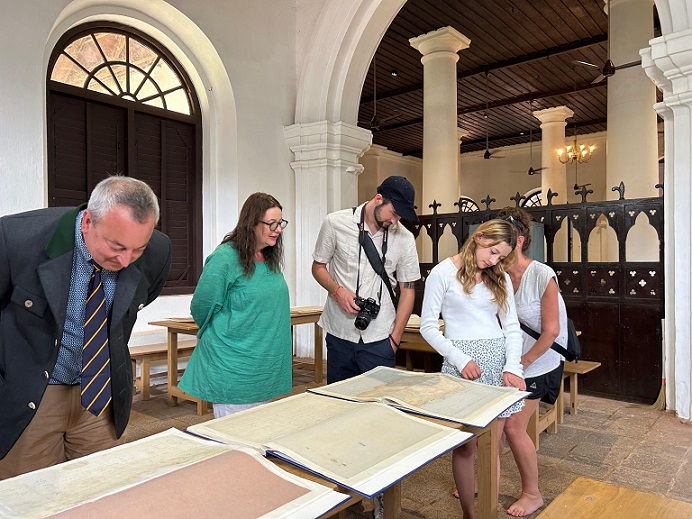
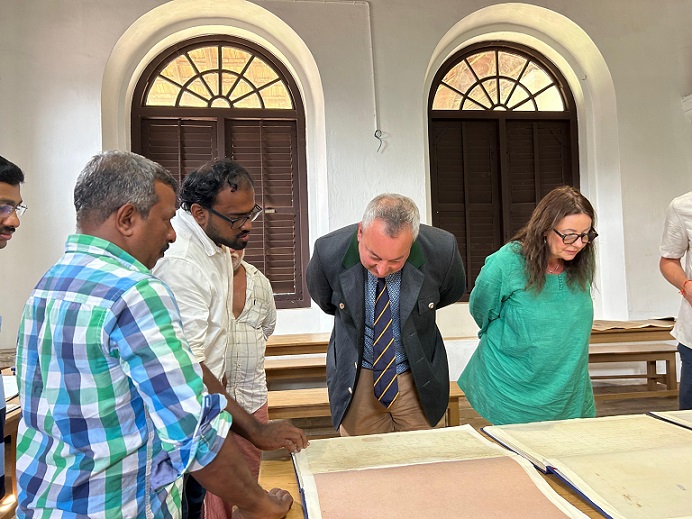
- The descendants of Murdoch Brown engaging with archival documents at the church alongside City Heritage Director Muhammed Shihad.
Founded in 1811, St. John’s Church preserves valuable colonial-era records including birth registers, death records, memorials, and inscriptions.
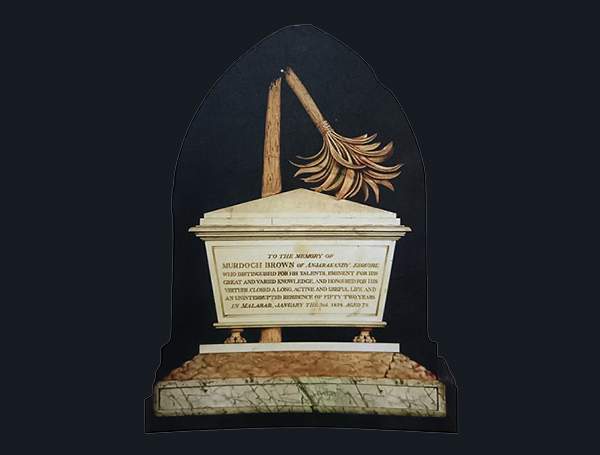
One of the most important moments for the Brown family was witnessing the famous white stone memorial dedicated to Murdoch Brown inside the church prepared by the artist John Meson.
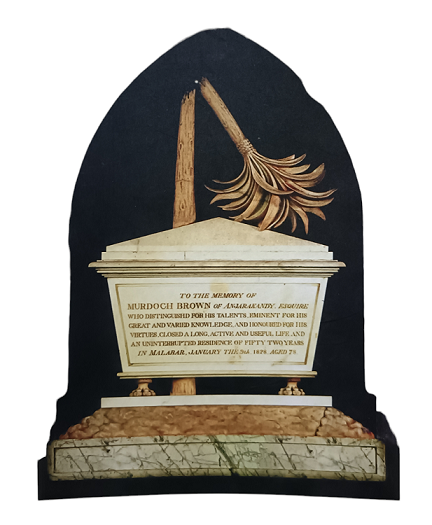
- White stone memorial dedicated to Murdoch Brown inside the St. John's English Church in Kannur.
The inscription reads:
"TO THE MEMORY OF MURDOCH BROWN OF ANJARAKANDY ESQUIRE WHO DISTINGUISHED FOR HIS TALENTS EMINENT FOR HIS GREAT AND VARIED KNOWLEDGE AND HONOURED FOR HIS VIRTUES CLOSED ALONG ACTIVE AND USEFUL LIFE AND AN UNINTERRUPTED RESIDENCE OF FIFTY-TWO YEARS IN MALABAR JANUARY THESA 1828 AGED 76."
For the family, the memorial represented more than a historical artifact — it became a deeply personal bridge connecting generations across continents and centuries.
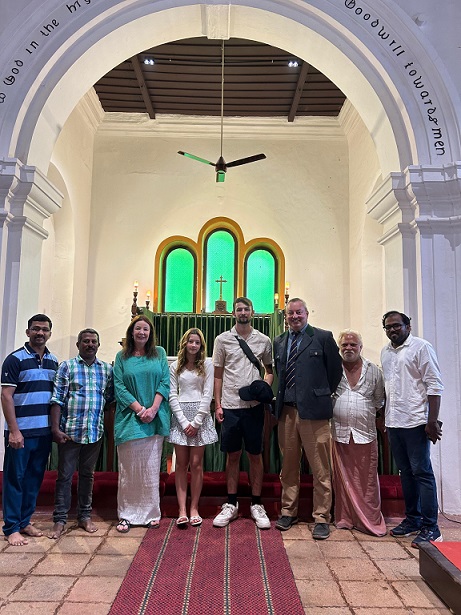
- The Brown family with City Heritage Director Muhammed Shihad and members of the church community.
Preserving the True History of Malabar
The efforts of City Heritage also brought attention to several historical confusions and inaccuracies surrounding Murdoch Brown and colonial-era records in Kerala.
Some narratives, including references connected to the first land registration office in India, require deeper historical verification and careful archival research.
By using original documents, church archives, inscriptions, and historical references, City Heritage continues to emphasize the importance of preserving history responsibly and accurately.
The story of Murdoch Brown is ultimately the story of Malabar itself — a region shaped by global trade, colonial ambitions, resistance, and cultural encounters.
And through the efforts of heritage initiatives and historical preservation, these forgotten stories continue to live once again on the shores of Kerala.
References:
1. Murdoch Brown, (1750-1828) the early days - Blog by Nick Balmer: https://malabardays.blogspot.com/2007/12/murdoch-brown-1750-1828-early-days.html
2. Murdoch Brown, Overseer of the Randattara Plantation. Part 1 - Blog by Nick Balmer: https://malabardays.blogspot.com/2009/01/murdoch-brown-overseer-of-randattara.html




 (1).png)
© Copyright 2026 City Heritage. All rights reserved.
Website designed by TNM Online Solutions.
If you have any enquiry, feel free to ask, and we'll provide you with a prompt and concise response.