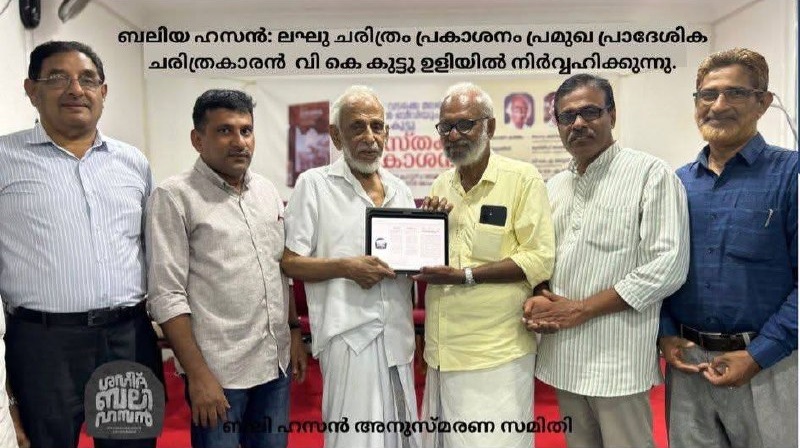
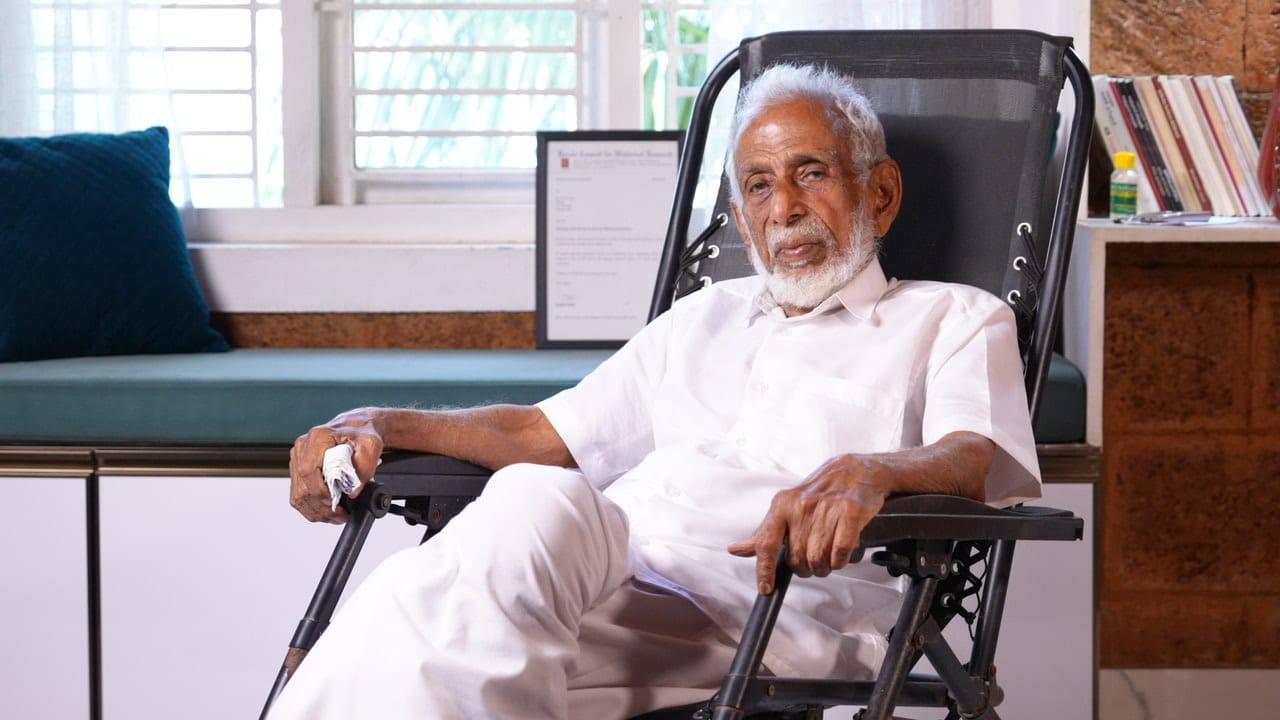
Some people study history. Some write history. A rare few dedicate their lives to preserving the histories that might otherwise be forgotten. V.K. Kuttu Sahib, affectionately known as “Kuttu Sahib,” belonged to that rare category. Though not formally trained as a professional historian, he devoted the later years of his life to documenting the social, cultural, political, and economic history of North Malabar, leaving behind an invaluable legacy for future generations.
For City Heritage, an organization devoted to the study, documentation, conservation, and celebration of the rich history and heritage of Malabar, he was far more than a source of knowledge. He was a trusted mentor and guiding force whose profound understanding of the heritage and history of North Malabar helped shape our journey from its very foundations and illuminate the path ahead. City Heritage shared a close and enduring association with him, and his insights played a vital role in shaping the organization.
Born in 1934 as Kunnath Kutti Hassan in the historic Kunnath Tharavad of Thalassery, he grew up in a traditional Muslim matrilineal Janmi household. The sprawling ancestral compound consisted of six two-storey buildings arranged around two large courtyards and housed members of several related family branches. The vibrant atmosphere of this traditional tharavad, filled with stories, customs, and memories, nurtured in him a lifelong curiosity about people, places, and the past.
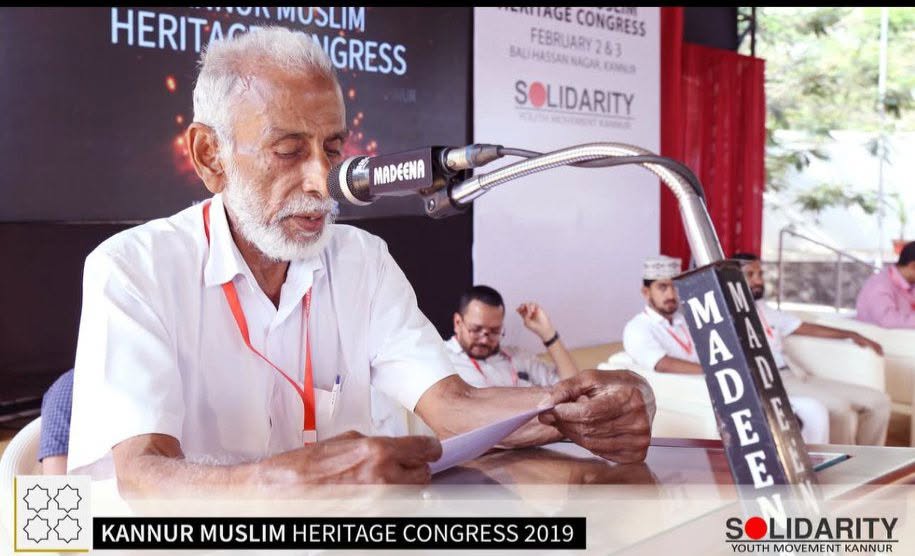
- V.K. Kuttu Sahib during the Kannur Muslim Heritage Congress held in 2019.
His early education began at Ta'limul Awam Madrasa LP School, where religious studies were taught alongside subjects prescribed under the government syllabus. These humble beginnings would eventually shape a man who would become one of the most respected local historians of North Malabar.
An interesting episode from his childhood led to the name by which he would later become widely known. Originally named Kunnath Kutti Hassan, he secured admission to BEMP High School through the assistance of neighbours who recognized his potential. During the admission process, his name was entered as “V.K. Kuttu.” The name remained with him throughout his life, appearing in his school records, college certificates, and passport.
After completing his education, Kuttu Sahib obtained a Diploma in Animal Husbandry from Madras Veterinary College. He built a successful career in the agricultural sector and became known as an excellent farmer and dedicated social worker. Yet history remained his abiding passion.
A Journey to Historian
For much of his life, he quietly collected stories, memories, and fragments of local history. The defining turning point came in 2007 when he underwent treatment for a cancerous tumour. During his recovery, memories of old Thalassery resurfaced vividly—the bustling harbour, ships anchored off the coast, the commercial life of the town, and the changing social landscape of Malabar. These recollections inspired him to embark on a remarkable mission: preserving the historical memory of North Malabar before it disappeared forever.
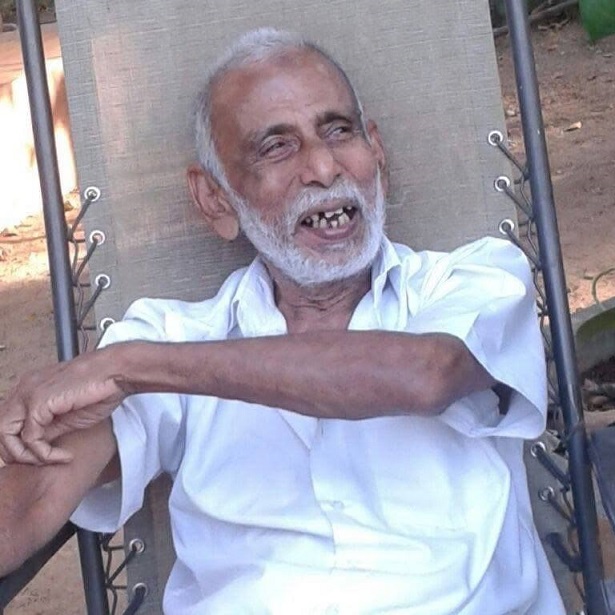
At an age when many people retire from active pursuits, Kuttu Sahib began a new life as a writer and researcher. He travelled extensively across Malabar, collecting oral histories, family records, palm-leaf manuscripts, archival documents, photographs, and forgotten local narratives. He pieced together information scattered across generations, often relying on personal interviews and community memory. His work was driven not by institutional support but by personal commitment. He became one of the rare local historians who moved from village to village gathering evidence and preserving historical materials in his own archives.
Reclaiming Malabar’s Past: History Beyond Colonial Narratives
What distinguished Kuttu Sahib was not merely the volume of information he collected but the way he approached history itself. One of his most significant contributions was his insistence on a critical examination of historical sources. He often remarked that “the history of the defeated cannot be understood solely through the documents of the victors.” This principle guided much of his research and interpretation of Malabar’s past. While he valued archival records, he believed that historical truth emerges only when official documents are read alongside local traditions, oral histories, family memories, and neglected evidence.
This approach frequently led him to challenge established historical narratives. A notable example concerned the history of Thalassery itself. In the nineteenth century, William Logan, the Deputy Collector of Malabar and author of the Malabar Manual, suggested that Thalassery developed as a significant settlement only after the arrival of the British East India Company. Kuttu Sahib questioned this interpretation through meticulous archival research. Examining records preserved in the Madras Archives, he uncovered letters written by East India Company officials nearly 150 years before Logan’s account. These documents revealed that Arab, Dutch, and French merchants were already actively engaged in the spice trade at Thalassery and that the Company initially struggled to establish itself because of the strength of existing trading networks. By bringing such evidence to light, Kuttu Sahib demonstrated that Thalassery had been an important centre of international commerce long before British dominance.
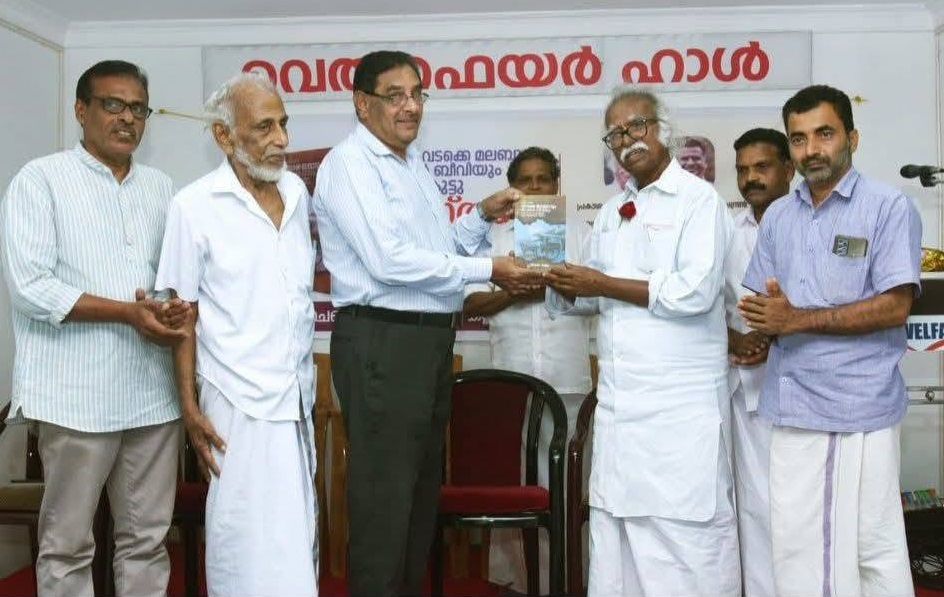
- Kadannappalli Ramachandran launching Pracheena Vadakke Malabarum Arakkal Beeviyum, authored by V.K. Kuttu Sahib.
His commitment to historical accuracy also led him to revisit accepted narratives concerning the Arakkal Kingdom. He argued that many interpretations of Arakkal history relied excessively on colonial records while giving insufficient attention to indigenous sources and local traditions. In this context, he critically engaged with the work of eminent historians and maintained that certain narratives adopted from British accounts required closer scrutiny in the light of regional evidence and oral traditions. Through such efforts, he encouraged a more nuanced understanding of Malabar’s past—one that moved beyond colonial interpretations and sought to recover voices often overlooked in conventional historical writing.
Books that Reframed Malabar’s Past
The result of his dedication was a remarkable series of publications that enriched Malayalam historical literature.
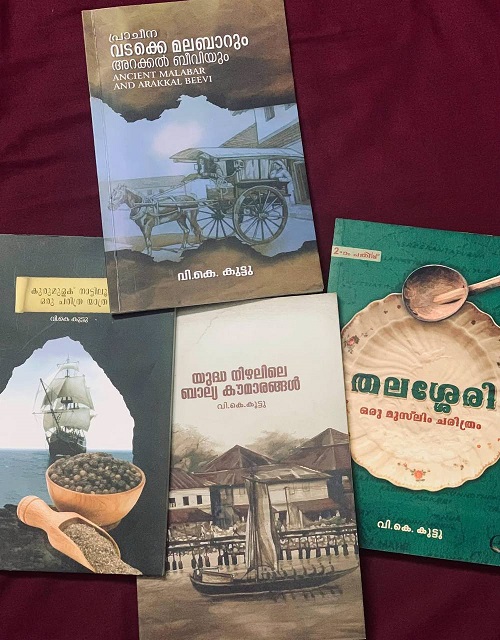
His major works include:
1. Thalassery: Oru Muslim Charithram (2010) – a detailed account of the people, institutions, trade networks, and social life of Muslims in the historic port town of Thalassery.
2. Kurumulak Nattiloode Oru Charithra Yathra (2014) – an exploration of the history of pepper and its role in shaping the political, economic, commercial, and colonial history of Malabar.
3. Yuddha Nizhalile Kaumarangal (2021) – a memoir-based historical narrative combining childhood experiences with the broader impact of the Second World War on Malabar society.
4. Pracheena Vadakke Malabarum Arakkal Beeviyum (2024) – a research-based study highlighting the role of the Arakkal dynasty and the resistance of the Arakkal Beevis against colonial powers.
Pepper, Trade, and the Colonial Resistance of Malabar
Among all the themes that occupied his attention, pepper held a special place. For Kuttu Sahib, pepper was not merely an agricultural product or a subject of historical study—it was central to understanding the history of Malabar itself. A farmer as well as a historian, he cultivated pepper on his own land and saw a direct connection between the soil of Malabar and the region’s global significance.
He often described how pepper transformed Malabar into a crossroads of civilizations. For centuries, traders, sailors, and explorers from Arabia, Europe, and other parts of Asia came to the Malabar Coast in search of spices. The desire to control the pepper trade shaped political alliances, inspired voyages across oceans, and contributed to conflicts that altered the course of world history. In his view, this long history of trade also helped create the plural and cosmopolitan character of Malabar society.
He took particular pride in the world-renowned Tellicherry Pepper, internationally known as Tellicherry Garbled Black Pepper (TGB), regarded as one of the finest varieties of black pepper in the world. Its global reputation stood, for him, as a living reminder of Malabar’s enduring place in international trade networks.
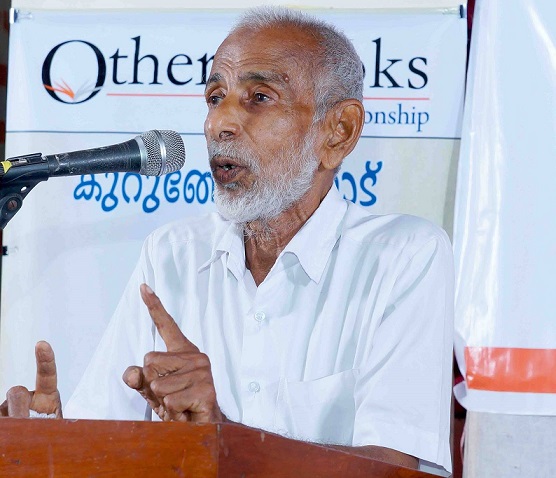
- V.K. Kuttu Sahib during the launch of Kurungottu Naadu, organized by Other Books.
Kuttu Sahib consistently emphasized the strategic importance of Thalassery and its surrounding region in maritime history. Situated near the ports of Thalassery, Dharmadom, and Mahe, and connected to the hinterland through navigable rivers, the region offered ideal conditions for commerce. The availability of timber, skilled craftsmen, and traditional shipbuilders made it an important centre for the construction of large wooden vessels.
According to Kuttu Sahib, these advantages attracted traders from diverse backgrounds, helping transform Thalassery into one of the most cosmopolitan towns on the Malabar Coast. Gujaratis, Kutchi merchants, Bhatkalis, Arabs, Europeans, and numerous local trading communities established networks linking Malabar with ports across the Indian Ocean. He often referred to classical references, including Pliny’s observations on the immense flow of gold into Kerala in exchange for pepper, as well as archaeological discoveries such as Roman coins unearthed from Kottayathangadi near Thalassery, which testified to the region’s extensive global connections nearly two thousand years ago.
"I had the opportunity to interview him twice. He possessed extraordinary knowledge about the ancient pepper trade of Kannur. Few people knew the depth of his historical understanding. Today, this wise elder has quietly departed. He knew by heart the old warehouses and customs collection centres that once existed in Kannur. Every grain of sand in Thalassery and Kannur seemed familiar to him. He personally showed me the surviving remnants of old customs houses in Thalassery."
Kuttu Sahib’s interests extended beyond historical research. He remained active in social causes, including anti-drug awareness initiatives, and participated in public discussions on cultural and social issues.
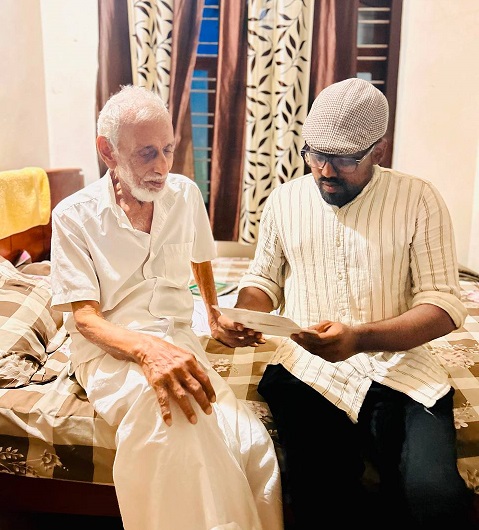
- City Heritage Founder Muhammed Shihad interacting with V.K. Kuttu Sahib.
What made him truly unique was the way he connected history with everyday life. His research was never confined to libraries and archives. Whether cultivating pepper on his farm, speaking with elderly residents, studying old documents, tracing forgotten trade routes, or mentoring young researchers, he approached history as something deeply rooted in the land and communities of Malabar.
V.K. Kuttu Sahib passed away leaving behind a rich legacy of scholarship and historical preservation. His death marked the end of a remarkable journey, but his work continues to guide researchers, inspire heritage enthusiasts, and illuminate the history of North Malabar for generations to come.




 (1).png)
© Copyright 2026 City Heritage. All rights reserved.
Website designed by TNM Online Solutions.
If you have any enquiry, feel free to ask, and we'll provide you with a prompt and concise response.